Full Reps Vs Half Reps: Which Is More Effective For Muscle Growth And Strength?
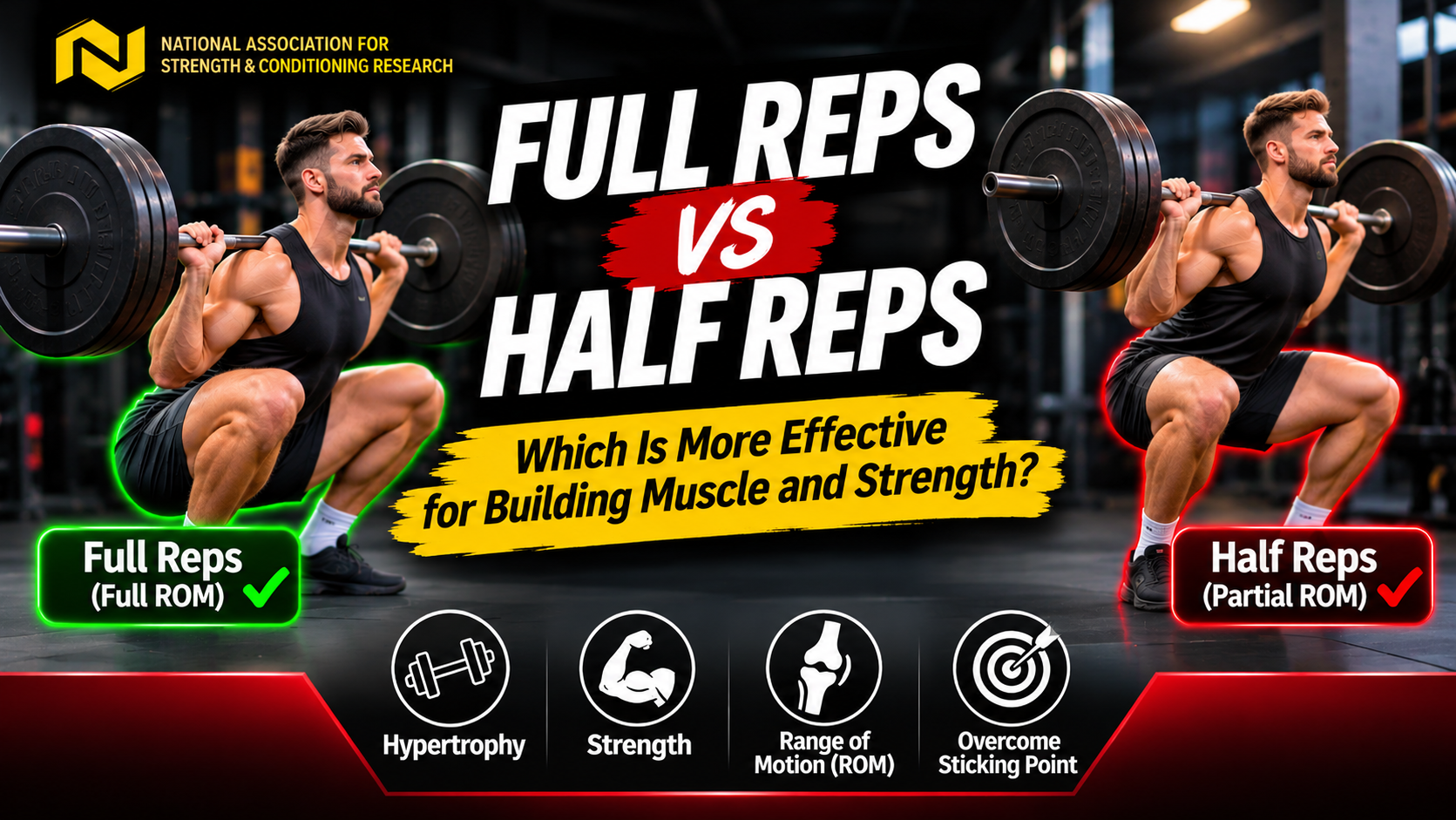
Is Full Range of Motion always superior, or could Partial Repetitions offer benefits that many lifters overlook?
In resistance training, one of the most common instructions given by fitness coaches is to perform every repetition through a full range of motion (Full ROM). When someone performs half repetitions, they are often criticised for using improper technique, lifting with their ego, or simply trying to move heavier weights.
But is this criticism scientifically justified?
Not necessarily.
Research in exercise science suggests that both Full Range of Motion (Full ROM) and Partial Range of Motion (Partial ROM) can produce valuable training adaptations. In fact, emerging research on lengthened partial repetitions has challenged the traditional assumption that Full ROM is always the best approach for maximising muscle hypertrophy. To understand which method is more effective, we must examine the biomechanics, physiology, and specific adaptations associated with each training approach.
1. Understanding Full ROM and Partial ROM
Full Range of Motion (Full ROM) refers to performing an exercise through the complete movement range that an individual can safely and effectively control. For example, during a squat, an individual lowers their body to an appropriate depth before returning to the standing position. The actual range depends on joint mobility, anatomical structure, movement control, and exercise objectives.
Partial Range of Motion (Partial ROM) involves performing an exercise through only a portion of the available movement range. For example, a half squat involves descending through a smaller range compared with a full squat. However, not all partial repetitions are the same. They can generally be classified into two categories:
Lengthened Partials
Repetitions performed within the portion of the movement where the target muscle is relatively lengthened.
Shortened Partials
Repetitions performed within the portion of the movement where the target muscle is relatively shortened.
This distinction is particularly important when discussing muscle hypertrophy.
2. Why Is Full Range of Motion Commonly Recommended?
Full ROM has traditionally been considered a fundamental principle of resistance training. This recommendation is supported by several important physiological and biomechanical considerations.
A. Strength Development Across a Wider Movement Range
Training through a full range of motion allows muscles to produce and control force across multiple joint angles. Although strength adaptations remain influenced by movement specificity, Full ROM generally provides broader strength development compared with training exclusively within a restricted range.
B. Consistent Muscle Hypertrophy
Full ROM provides an effective stimulus for muscle growth by exposing muscles to mechanical loading across different muscle lengths. For most individuals, it remains a reliable foundation for hypertrophy-oriented resistance training.
C. Neuromuscular Coordination
Performing exercises through a wider range requires coordinated activity between agonist, antagonist, and stabilising muscles. This contributes to motor control and movement proficiency across different joint positions.
D. Active Mobility
Resistance training performed through an appropriate range of motion may help maintain or improve active mobility. However, these advantages do not mean Partial ROM is ineffective.
3. Half Reps Are Not Necessarily Cheating
One of the biggest misconceptions in strength training is that partial repetitions automatically represent poor technique. In reality, Partial ROM has been used for decades in strength development, powerlifting, athletic conditioning, and rehabilitation. Consider the following examples.
Partial Squats
Athletes may use partial squats to develop force production at specific knee and hip angles.
Pin Press or Board Press
Powerlifters may use these exercises to strengthen particular portions of the bench press movement.
Rack Pulls
Strength athletes may perform rack pulls to overload selected portions of the deadlift.
These methods are associated with the principle of joint-angle specificity. This principle suggests that strength adaptations are partly specific to the joint angles and movement ranges used during training. Therefore, Partial ROM can be valuable when the objective is to improve strength within a particular movement range. However, lifting heavier weights through a shorter range does not automatically mean the muscles receive a greater hypertrophy stimulus. External load is only one component of the overall training stimulus.
4. Lengthened Partials: Why Is Exercise Science Paying More Attention?
In recent years, researchers have increasingly investigated the effects of resistance training performed at longer muscle lengths. This approach is often referred to as lengthened-position training. The underlying concept involves exposing muscles to mechanical tension while they are relatively lengthened. Depending on the exercise and muscle involved, loading at longer muscle lengths may influence both active force production and passive tension within muscle-tendon structures.
Several studies have reported that training at longer muscle lengths can produce muscle hypertrophy comparable to, or sometimes greater than, training through a full range of motion. This has led to increasing interest in Lengthened Partial Repetitions. However, an important distinction must be made.
The available evidence does not establish that Lengthened Partials are universally superior to Full ROM for every muscle group or exercise.
Research outcomes vary depending on the muscles investigated, exercise selection, participant training experience, intervention duration, and measurement methods. Long-term evidence is also still developing. Therefore, Lengthened Partials should be viewed as a potentially effective hypertrophy strategy rather than a universal replacement for Full ROM.
5. Practical Example: Biceps Curl
Consider three different ways of performing a biceps curl.
Method 1: Full ROM
The individual begins with the elbow nearly extended, curls the dumbbell upward, and returns to the starting position under control. This exposes the elbow flexors to resistance across a relatively wide movement range.
Method 2: Lengthened Partials
The individual performs repetitions only within the lower portion of the curl, where the elbow flexors are relatively lengthened.
Method 3: Shortened Partials
The individual performs repetitions only within the upper portion of the curl, where the elbow flexors are relatively shortened. Although all three methods involve the biceps, they do not necessarily produce identical mechanical or physiological stimuli. Joint position affects muscle length, force-producing capacity, and the external resistance profile. For example, during a standing dumbbell curl, the external moment arm changes throughout the movement because gravity acts vertically.
This means that the position where the biceps is most lengthened is not necessarily the position where the external elbow torque is greatest. Therefore, understanding the biomechanics of an exercise is essential before assuming that a particular partial range is superior.
6. Is a 150 kg Half Squat Better Than a 100 kg Full Squat?
This is one of the most interesting questions in resistance training.
Imagine an individual performing:
- Full Squat: 100 kg × 8 repetitions.
- Half Squat: 150 kg × 8 repetitions.
The half squat uses 50% more external load.
Does this mean the muscles receive 50% more stimulation?
No.
Muscle hypertrophy cannot be predicted from external load alone.
Several variables influence the training stimulus, including muscle length, joint torque, movement range, effort, proximity to muscular failure, training volume, and recovery capacity. During a half squat, an individual may lift significantly heavier loads because the movement occurs within mechanically advantageous joint positions. In contrast, a deeper squat may expose certain muscles to greater lengths and different mechanical demands. Therefore, a 150 kg half squat cannot automatically be considered more effective for hypertrophy than a 100 kg full squat. Nevertheless, the heavier partial squat may still provide valuable strength adaptations within the trained range. The correct interpretation depends on the intended training outcome.
7. Does Higher EMG Activity Mean Greater Muscle Growth?
Another common misconception involves the interpretation of electromyography (EMG). Some individuals assume that if Half Reps produce higher EMG readings than Full Reps, they must be more effective for muscle growth. This conclusion is scientifically questionable. EMG measures electrical activity associated with muscle activation. It does not directly measure muscle hypertrophy. EMG amplitude can be influenced by several factors, including electrode placement, muscle length, fatigue, movement velocity, and neuromuscular recruitment strategies.
A higher EMG reading does not necessarily translate into greater long-term muscle growth. When evaluating hypertrophy, longitudinal studies that directly measure changes in muscle size provide more relevant evidence than acute EMG comparisons alone. Therefore, exercise selection should not be based exclusively on which movement produces the highest EMG signal.
8. Full ROM vs Partial ROM for Strength Development
When the primary objective is to improve strength through a complete movement pattern, Full ROM should generally remain a major component of training. For example, a powerlifter preparing for competition must develop strength at the squat depth required by the rules. Training exclusively with half squats may improve strength within the upper movement range, but these improvements may not transfer completely to deeper positions. This is because strength adaptations are partly specific to the trained joint angles.
However, Partial ROM can be used strategically as an accessory method. For example, pin squats and pin presses may help athletes develop force production within particular movement ranges. Similarly, certain sports require athletes to generate high levels of force at specific joint positions. In these situations, Partial ROM may have practical applications. The important consideration is whether the exercise matches the actual biomechanical demands of the athlete’s sport.
9. How Should Full ROM and Partial ROM Be Combined?
For individuals seeking both muscle hypertrophy and strength development, a practical approach is to use Full ROM as the foundation while incorporating Partial ROM for specific purposes.
Primary Exercises
Perform compound movements through an appropriate, controlled range of motion. Examples include squats, presses, rows, and other fundamental resistance exercises.
Hypertrophy Accessories
Lengthened Partials may be incorporated into selected exercises where the resistance profile and muscle-length characteristics support their use. However, they are not mandatory for effective hypertrophy training.
Specific Strength Development
Partial ROM exercises such as pin squats, rack pulls, or pin presses can be introduced to address specific strength requirements. The amount and frequency of partial-range training should be determined by the individual’s goals, training experience, fatigue management, and recovery capacity. Importantly, a well-designed Full ROM programme can already produce excellent improvements in strength and muscle mass. Partial ROM should therefore serve a clear training purpose rather than being included simply because it allows heavier weights to be lifted.
10. What Does the Scientific Evidence Suggest?
Current research supports several important conclusions. First, Full ROM remains an effective and generally reliable method for developing muscle size and strength across a broad movement range. Second, Partial ROM can produce meaningful adaptations, particularly within the joint angles being trained. Third, partial repetitions performed at longer muscle lengths may provide substantial hypertrophy benefits. Fourth, the effectiveness of Lengthened Partials compared with Full ROM appears to depend on the exercise, target muscle, and training conditions. Finally, the ability to lift heavier external loads through Partial ROM does not automatically indicate a superior muscle-building stimulus.
These findings reinforce the importance of understanding mechanical tension, muscle length, movement specificity, and progressive overload rather than evaluating exercise effectiveness based solely on external weight or movement distance.
11. Conclusion: Range of Motion Is a Training Variable, Not a Competition
The debate between Full Reps and Half Reps highlights an important principle in exercise science.
There is no single range of motion that is universally optimal for every individual, muscle group, and training objective.
Full ROM provides valuable benefits for developing strength across a wider movement range, improving movement proficiency, and stimulating muscle hypertrophy. Partial ROM offers specific applications for joint-angle strength development, movement-range management, and potentially muscle growth when performed at longer muscle lengths.
However, not all partial repetitions are equal. Lengthened Partials and Shortened Partials can produce different mechanical stimuli despite both involving restricted movement ranges. For fitness professionals, the important question should not simply be whether Full Reps or Half Reps are better.
Instead, coaches should ask:
What adaptation are we trying to achieve, and which range of motion provides the most appropriate stimulus for that objective?
A qualified coach does more than instruct clients to move a weight from point A to point B. A qualified coach understands why a particular range of motion is selected, how mechanical loading changes throughout the movement, and how the exercise should be programmed to achieve the intended adaptation. Ultimately, effective resistance training is not determined solely by how far the weight moves. It is determined by how the muscles are challenged, how the training stimulus is managed, and how the body adapts over time.
Full Reps are not always superior. Half Reps are not automatically cheating. The effectiveness of either method depends on how and why it is used.
References
- Schoenfeld, B. J., & Grgic, J. (2020). Effects of range of motion on muscle development during resistance training interventions: A systematic review. SAGE Open Medicine.
- Kassiano, W., et al. (2023). Greater gastrocnemius muscle hypertrophy after partial range of motion training performed at long muscle lengths. Journal of Strength and Conditioning Research.
- Pedrosa, G. F., et al. (2022). Training in the initial range of motion promotes greater muscle adaptations than at final range of motion in the arm curl. Sports.
- Wolf, M., et al. (2025). Lengthened partial repetitions elicit similar muscular adaptations as full range of motion repetitions. European Journal of Sport Science.