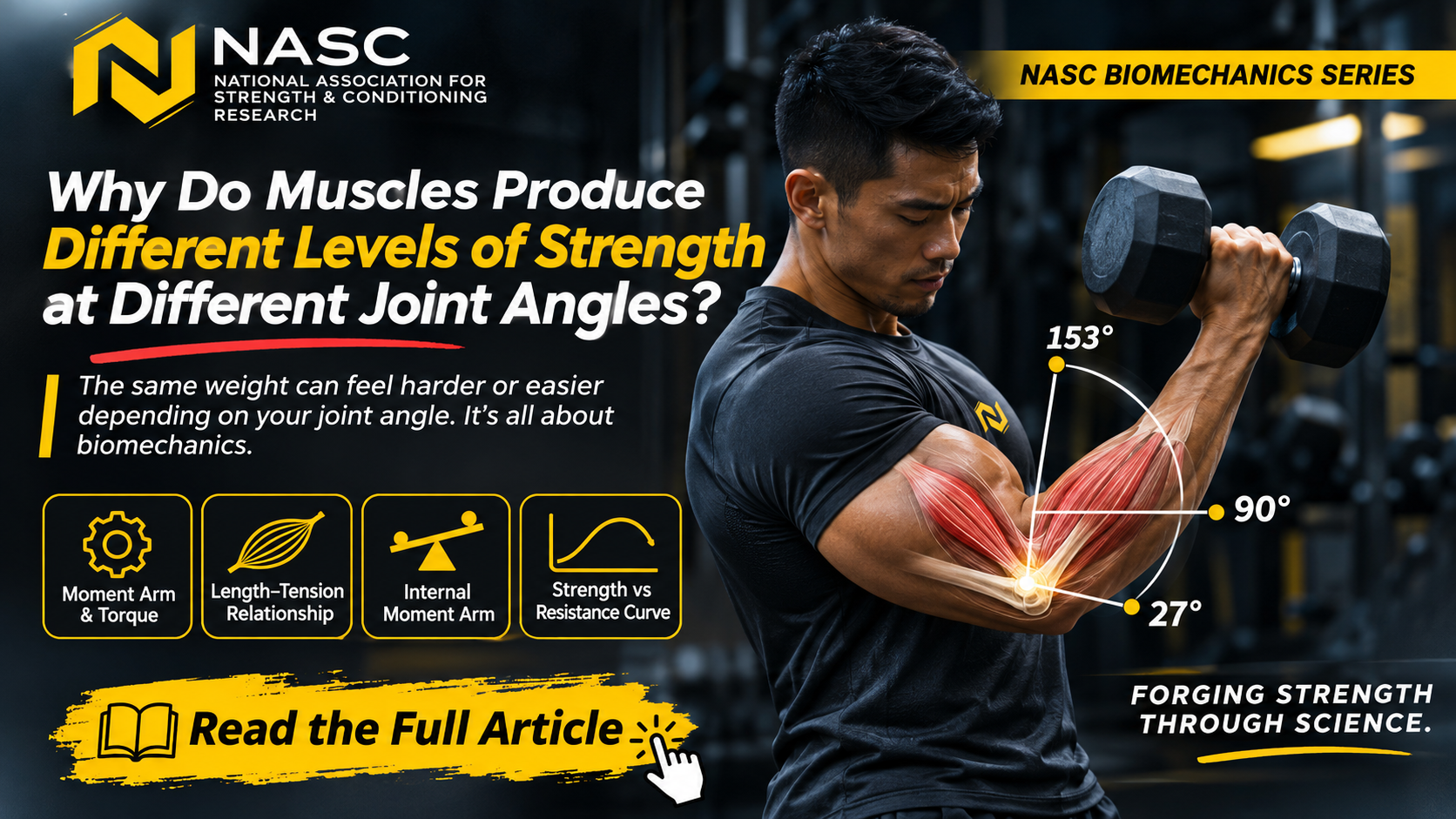
Why Do Muscles Produce Different Levels of Strength at Different Joint Angles?
Have you ever performed a biceps curl and noticed that the dumbbell feels heavier in the middle of the movement but lighter towards the beginning or end? Although the weight of the dumbbell remains unchanged, the mechanical demands placed on the muscles vary throughout the movement. This phenomenon can be explained through several fundamental principles of biomechanics and muscle physiology.
1. Moment Arm and Torque
A moment arm is the perpendicular distance between the axis of joint rotation and the line of action of a force. Torque refers to the rotational effect of a force acting around an axis.
The formula for torque is:
τ = F x dt
Where:
-
τ = Torque (Nm)
-
F = Force (N)
-
dt = Perpendicular moment arm (m)
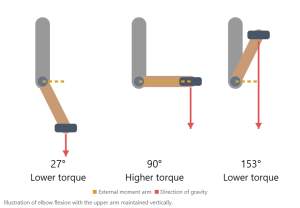
During a standing dumbbell biceps curl, the external torque generated by the dumbbell reaches its maximum when the forearm is horizontal, assuming the upper arm remains vertical.
Practical example
Consider a 10 kg dumbbell producing approximately 98.1 N of gravitational force.
| External moment arm | External torque |
|---|---|
| 10 cm | 9.81 Nm |
| 20 cm | 19.62 Nm |
| 30 cm | 29.43 Nm |
Although the dumbbell weighs exactly the same, the external torque can increase threefold in this example. This calculation excludes the weight of the limb and the effects of acceleration.
The weight remains constant, but the mechanical demand changes. [1]
2. Length-Tension Relationship
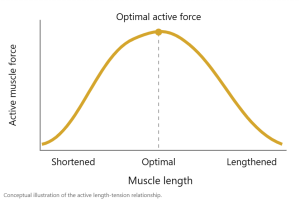
The ability of a muscle to generate active force is influenced by its length and the degree of overlap between actin and myosin filaments within the sarcomere.
| Muscle condition | Active force production |
|---|---|
| Excessively shortened | Reduced force production |
| Optimal length | Maximum active force production |
| Excessively lengthened | Reduced active force production |
At an optimal sarcomere length, actin and myosin interactions allow greater active force production. However, when the sarcomere becomes excessively shortened or lengthened, its ability to generate active force decreases. Passive tension from elastic structures within the muscle may also increase as the muscle lengthens. The landmark study by Gordon, Huxley and Julian (1966) demonstrated the relationship between sarcomere length and isometric force production. [2]
3. Internal Moment Arm
Muscles also possess an internal moment arm, which is the perpendicular distance between the muscle’s line of action and the joint’s axis of rotation.
Muscular torque can be expressed as:
τₘ = Fₘ x dₘ
Where:
-
τₘ = Muscular torque
-
Fₘ = Muscle force
-
dₘ = Internal moment arm
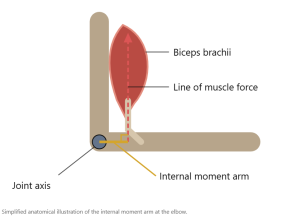
As joint angles change, the internal moment arm may also change, affecting the mechanical advantage of the muscle. A larger internal moment arm allows a muscle to generate greater joint torque for the same amount of muscle force. Research by Murray et al. (1995) demonstrated that the moment arms of muscles crossing the elbow joint vary according to elbow and forearm positions. [3] Therefore, muscular strength at a particular joint angle depends not only on muscle force production but also on mechanical leverage.
4. Strength Curve vs Resistance Curve
Understanding the relationship between strength curves and resistance curves is essential for effective exercise selection and programme design.
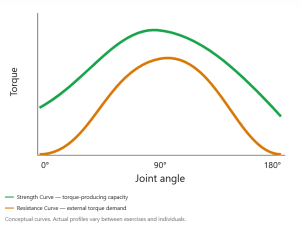
Strength Curve
Represents an individual’s capacity to produce joint torque at different joint angles.
Resistance Curve
Represents the external torque demand imposed by resistance throughout the range of motion. When external torque demand approaches an individual’s maximum torque-producing capacity, the movement becomes increasingly difficult. This interaction, together with momentum, fatigue and neuromuscular coordination, helps explain the occurrence of a sticking point during resistance training. [4]
5. Joint Angle Specificity
Strength adaptations are partly specific to the joint angles at which training is performed. For example, performing isometric elbow flexion at 90° may produce greater strength improvements at or near that particular joint angle, although improvements can also transfer to other angles.
This principle has important applications in:
-
Strength and conditioning.
-
Sports performance.
-
Rehabilitation.
-
Sticking point management.
-
Targeted strength development.
Research on isometric training supports the importance of joint angle and muscle length when developing strength. [5,6]
6. Different Equipment, Different Mechanical Demands
Even when exercises target the same muscle group, different training equipment can produce different resistance profiles.
Dumbbell Biceps Curl
Resistance acts vertically due to gravity. External torque is greatest when the moment arm is longest.
Cable Biceps Curl
The direction of resistance depends on the position of the pulley relative to the joint.
Resistance Band Biceps Curl
Band tension generally increases as the band stretches, while joint torque also depends on the changing moment arm.
Machine Biceps Curl
The resistance profile may be manipulated through the machine’s lever arms, pulley systems and cam design.
Understanding these differences allows Personal Trainers to select exercises according to their intended mechanical demands rather than simply targeting a particular muscle group.
7. Practical Applications for Personal Trainers
A Personal Trainer who understands biomechanics can make better decisions regarding exercise selection, resistance manipulation, range of motion, targeted isometric training, individual mechanical differences and sticking point management. Instead of simply increasing the weight or number of repetitions, trainers should consider how resistance interacts with muscular capacity throughout the entire movement. Effective programme design requires an understanding of both the forces acting on the body and the body’s ability to overcome those forces.
Conclusion
Muscular strength is not constant throughout a movement. It is influenced by several interacting factors, including muscle length, joint angle, internal and external moment arms, resistance profiles and neuromuscular capacity.
The same weight does not necessarily produce the same mechanical demand at every joint angle.
A knowledgeable Personal Trainer does not merely understand which muscles an exercise targets but also understands how and why the exercise challenges those muscles. Understanding biomechanics is the difference between simply prescribing exercises and designing scientifically informed training programmes.
References
5. Oranchuk, D. J., Storey, A. G., Nelson, A. R., & Cronin, J. B. (2019). Isometric training and long-term adaptations: Effects of muscle length, intensity, and intent: A systematic review. Scandinavian Journal of Medicine & Science in Sports
6. Kitai, T. A., & Sale, D. G. (1989). Specificity of joint angle in isometric training. European Journal of Applied Physiology and Occupational Physiology